Why an Outdoor Golf Setup Is Worth the Investment
Golf improvement takes repetition. Driving ranges are helpful, but they are not always available. Weather, time, and cost can all get in the way. Therefore, building your own outdoor golf setup at home is one of the smartest moves you can make as a golfer.
A proper outdoor setup lets you practice on your schedule. You can work on your swing in the morning before work. You can hit balls in the evening after dinner. Additionally, you track your progress with real data using a launch monitor. Over time, this kind of consistent practice leads to real improvement on the course.
This guide will walk you through everything you need. From choosing the right space to picking the best gear, you will learn how to build a setup that works for your game and your budget.
Choosing the Right Space in Your Yard
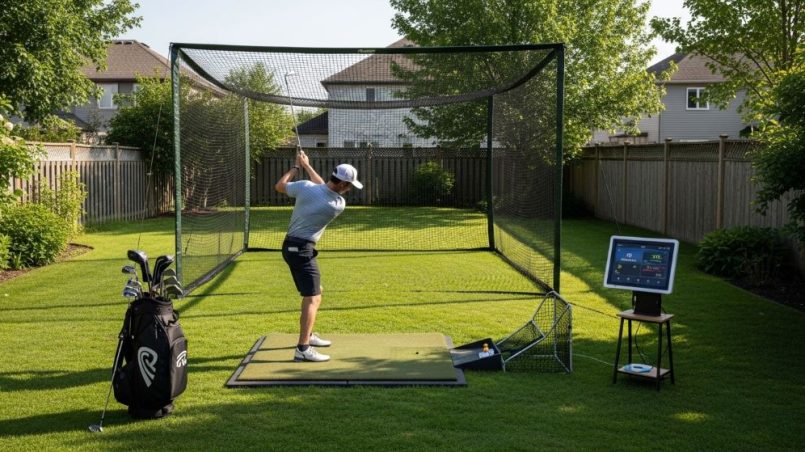
The first step is finding the right location. You do not need a massive yard. However, you do need enough room to swing freely and safely.
For a standard setup, aim for at least 10 to 15 feet of width and 20 feet of depth. This gives you enough room to position your hitting area, your net, and your launch monitor. If you have more space, that is even better.
Check the ground surface as well. A flat, level area is ideal. Grass works well because it gives you a natural feel underfoot. However, concrete or pavers can also work if you use an artificial turf mat on top.
Think about lighting too. If you plan to practice in the early morning or evening, some basic outdoor lighting will help. Additionally, consider shade. Practicing in direct afternoon sun can be uncomfortable, and glare can interfere with some launch monitor screens.
Understanding Launch Monitors and How to Use Them Outdoors
A launch monitor is the brain of your outdoor golf setup. It measures your swing and ball flight using radar or camera technology. The data it provides includes ball speed, launch angle, spin rate, carry distance, and more.
There are several good options available today. Entry-level models like the Rapsodo MLM2PRO or the Garmin Approach R10 are affordable and accurate. Mid-range options like the Flightscope Mevo Plus offer more data points. Premium models like the Trackman or Foresight GCQuad deliver professional-grade accuracy.
For outdoor use, radar-based monitors tend to work best. They track real ball flight without needing a screen or net behind the ball. Therefore, you get the most accurate data possible when you use them outside.
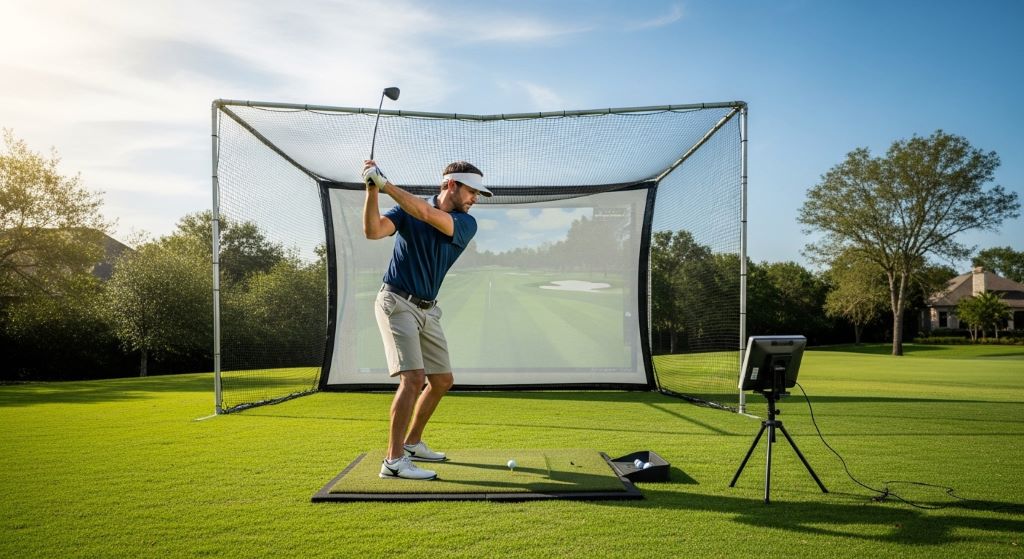
Place your launch monitor about 6 to 8 inches behind the ball on the ground, or slightly to the side depending on the model. Follow the manufacturer’s instructions carefully. Alignment matters a lot for accurate readings.
Selecting Golf Nets and Impact Screens for Your Setup
This is one of the most important decisions you will make. Golf nets and impact screens serve different purposes, and understanding the difference helps you choose wisely.
Golf nets are designed to stop the ball safely. They are typically made from heavy-duty polyester or nylon netting. A quality net will absorb the force of a full-speed golf shot without tearing or stretching. They are perfect for outdoor use because they handle wind and weather well.
Impact screens, on the other hand, are used when you want to project a simulated course onto the screen. They are made from special woven material that withstands repeated ball strikes while also accepting a clear projected image. If you plan to use golf simulation software outdoors with a projector, an impact screen is what you need.
For a purely outdoor hitting setup focused on real ball flight, a sturdy net is usually enough. However, if you want to combine outdoor practice with simulation on cloudy days or in a shaded area, pairing golf nets and impact screens gives you the best of both worlds.
When shopping, look for nets that are at least 10 feet wide and 8 feet tall. Side barriers are a bonus because they catch off-center shots. Make sure the frame is made from steel or heavy-duty fiberglass so it holds up in wind.
Building a Comfortable Hitting Area
Your hitting station is where you will spend most of your time. Therefore, it deserves careful attention.
Start with a good hitting mat. Look for one that simulates real fairway turf. The mat should have enough thickness to protect your joints from the hard ground underneath. A mat around 4 feet by 5 feet gives you plenty of room for your stance and setup.
Place the mat on a stable, flat surface. If your yard has uneven ground, consider putting down a rubber base or a wooden platform first. This keeps the mat from shifting during your swing.
Add a ball tray or basket nearby so your balls are always within reach. A small side table is also useful for holding your phone, tablet, or launch monitor remote. These small details make practice sessions more efficient and enjoyable.
Additionally, think about comfort during longer sessions. A chair nearby, a small cooler with water, and sunscreen nearby can make a real difference on warm days.
Essential Accessories to Complete Your Setup
Beyond the net and launch monitor, a few accessories will take your outdoor setup to the next level.
Alignment sticks are simple but powerful training tools. Place them on the ground to check your stance and club path. They cost very little and teach you a lot.
A swing camera or phone mount is another great addition. Position your phone to record your swing from behind or from the side. Reviewing your swing on video helps you spot problems that you cannot feel. Many golfers find video feedback more valuable than any tip from a book.
A putting mat is worth adding if you have the space. Rolling a few putts after your full-swing session keeps your short game sharp. You do not need anything fancy — a simple 9-foot mat will do the job.
Wind speed can affect your outdoor practice. Therefore, a small digital anemometer is a handy tool. It measures wind speed so you can account for it when reviewing your launch monitor data.
Finally, consider a storage solution. A weatherproof box or small shed nearby keeps your mats, balls, and accessories protected when not in use.
Setting Up for Safety First
Safety is not optional. Golf balls travel at high speed and can cause serious damage or injury if your setup is not secure.
Always make sure your net is fully secured before hitting. Check the stakes or anchors before each session. Wind can loosen things overnight, so a quick check takes only a few seconds but could prevent an accident.
Position your net so that any ball that passes through — which should not happen with a quality net, but occasionally does — travels in a safe direction. Do not aim toward roads, fences with people on the other side, or windows.
Let neighbors know about your setup, especially if your yard is close to theirs. Most people are understanding, and a simple conversation avoids any future issues.
Children and pets should never be in the hitting zone during practice. Set a clear boundary and stick to it every time.
Weather Proofing and Maintaining Your Setup
Outdoor gear faces real challenges. Sun, rain, and wind will wear down your equipment over time. However, with a little care, you can extend the life of everything significantly.
Store your hitting mat indoors or under a weatherproof cover when not in use. UV exposure can cause mats to fade and crack over time. Most quality mats come with carrying bags, so take advantage of that.
For your net, rinse it with water occasionally to remove dirt and debris. Check the stitching and frame connections regularly. Tighten any bolts or connections that feel loose.
Launch monitors should always be stored indoors. Even models rated for outdoor use should not be left out overnight. Moisture and extreme temperatures can damage the internal sensors.
Cover your hitting area with a tarp if rain is expected. This keeps the mat dry and prevents the surface from becoming slippery.
Putting It All Together: A Simple Step-by-Step Summary
Building your outdoor golf setup does not have to be overwhelming. Here is a simple order of operations to follow:
- Choose your location and prepare the ground surface
- Set up your net or impact screen and secure it firmly
- Place your hitting mat in position in front of the net
- Position your launch monitor correctly behind or beside the ball
- Add accessories like alignment sticks, a phone mount, and a ball tray
- Test everything before your first full session
Take your time with each step. A well-built setup lasts for years and pays for itself many times over in range fees you will never have to spend.
Conclusion
Building an outdoor golf setup is one of the best investments a golfer can make. With the right location, a reliable launch monitor, quality golf nets and impact screens, and a few smart accessories, you create a practice environment that works on your schedule and improves your game.
The key is to start with a solid foundation. Choose durable equipment, keep safety in mind, and maintain your setup regularly. Additionally, use the data from your launch monitor to guide your practice rather than just hitting ball after ball without purpose.
Therefore, whether you are a weekend golfer looking to break 90 or a serious player working toward scratch, a home outdoor setup gives you the edge that consistent, data-driven practice provides. Start simple, build over time, and enjoy every session right in your own backyard.
Frequently Asked Questions
What size net do I need for an outdoor golf setup?
For most golfers, a net that is at least 10 feet wide and 8 feet tall is ideal. This catches the majority of shots, including off-center hits. Larger nets offer more coverage but require more space.
Can I use a launch monitor outside in all weather conditions?
Most launch monitors can be used outside in mild conditions, but they should be protected from rain and extreme heat. Always check the manufacturer’s weather rating before leaving your device outdoors.
Do I need an impact screen if I am practicing outdoors?
Not necessarily. If you are practicing with real ball flight and using a radar-based launch monitor, a standard net is sufficient. Impact screens are most useful when you want to add golf simulation with a projector to your setup.
How much space do I need for a backyard golf setup?
A minimum of 10 feet wide and 20 feet deep is recommended. More space gives you more flexibility and makes the setup feel more comfortable. Taller ceilings or open-air setups are better for drivers and long irons.
What is the best hitting mat for outdoor use?
Look for mats made from durable artificial turf with a thick rubber base. Mats designed for outdoor use typically have UV-resistant materials and drain water effectively. Popular brands include Fiberbuilt, Country Club Elite, and TrueStrike.
Related Topics:
How to Get a Bot Lobby in Fortnite: Easy Methods
How to Measure a Bike Frame With Some Easy Steps