You’ve just landed a bruiser of a bass on Lake Fork, the kind of fish that makes your arms shake and your heart pound. But when you go to weigh it, the scale gives you a wishy-washy number that you simply can’t trust. That’s a problem every serious Texas angler faces eventually. Without a reliable scale, that trophy catch is just a guess. You need to know exactly how to test heavy-duty scales for Texas fishing before you trust that number, and you need to know what to look for before you spend a dime. This guide is your step-by-step playbook for verifying accuracy, ensuring durability, and avoiding the rookie mistake of trusting a gadget that’s off by half a pound. Let’s make sure your next big fish is measured truthfully.
What Exactly Defines a “Heavy Duty” Fish Scale for Texas Waters?
A heavy duty fish scale is one that provides accurate, repeatable weight measurements up to at least 50 pounds, features a rugged, water-resistant construction, and includes a locking mechanism to hold the weight reading. In the context of Texas fishing—where you might chase freshwater monsters in the Rio Grande or redfish in the Gulf—a scale must withstand heat, humidity, salt spray, and the occasional drop onto a boat deck. It is not simply a scale with a high number on the box; it is a tool engineered for the abuse of real-world angling.
Key Components of a True Heavy-Duty Scale
When you inspect a scale, look for these three non-negotiable components:
- Load Cell Quality: This is the internal sensor that measures weight. High-grade load cells use stainless steel and precision strain gauges. If a scale is labeled “heavy duty,” the load cell must be rated for at least 20% above the maximum display weight to prevent burnout.
- Housing Material: ABS plastic is common, but a true heavy duty scale uses a rubberized armor coating or a full stainless steel shell to absorb impacts and resist corrosion from saltwater.
- Display Protection: Numbers are useless if the screen fogs up or gets cracked. Look for an IPX6 or IPX7 waterproof rating, which protects against heavy splashes or temporary submersion.
Why 50 lbs is the Magic Number in Texas
While you might only target 10-pound bass, the mechanical advantage of a 50-lb capacity scale is crucial. Here is why:
- Accuracy at Lower Weights: A 50-lb scale weighing a 5-lb fish is more accurate than a 500-lb scale doing the same job. The load cell is optimized for that range.
- Alligator Gar & Blue Catfish: Texas holds the world record for alligator gar (over 280 lbs), but even a “small” 50 lb gar is a possibility. You need headroom.
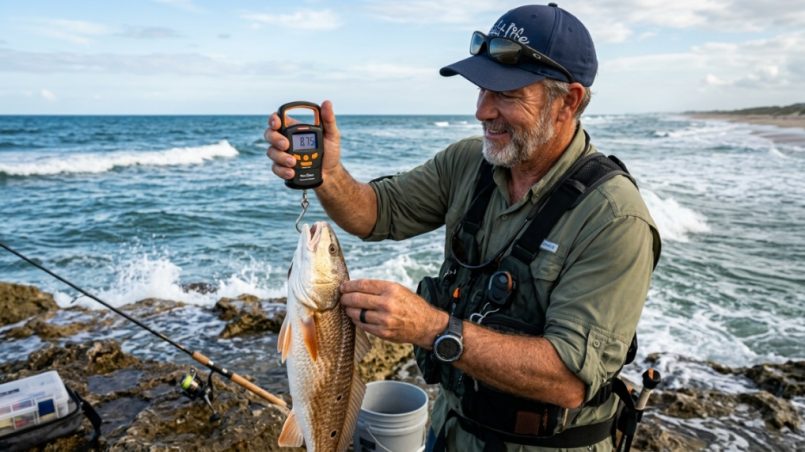
- Saltwater Tolerance: Redfish and speckled trout in the bays are often 20-30 lbs, but fighting a 40-inch redfish in the surf requires a scale that can handle sudden jerks.
How Can You Accurately Test a Fish Scale Without a Certified Weight?
You can test a fish scale accurately at home using a known weight, such as a dumbbell, a jug of water, or a bag of dog food. The key is to use a weight that you have verified with a separate, known-accurate source, like a shipping scale at a post office. This verifies both the scale’s calibration and its linearity—meaning it stays accurate across different weight ranges.
The 5-Step “Bucket Test” Method
Here is the most reliable way to test a scale at home without buying expensive calibration weights. This tests the scale’s repeatability and accuracy.
- Get a Baseline: Grab a 5-gallon plastic bucket and a standard 10-lb dumbbell. Weigh the dumbbell on a certified scale at a UPS or FedEx store. This is your benchmark.
- Test the Hook: Hang the empty bucket on the fish scale. Record the tare weight before zeroing out (if applicable). You need to know the bucket’s weight to add to your test.
- Load Incrementally: Place the 10-lb dumbbell in the bucket. The scale should read 10 lbs + the bucket weight. Then, add a second 10-lb dumbbell or a gallon of water (which weighs 8.34 lbs). This tests mid-range accuracy.
- Check the Peak Function: Most scales have a “peak weight” feature. Press the “mode” or “peak” button. Give the bucket a sharp tug upward to simulate a fish head-shake. The scale should lock the highest weight momentarily.
- Repeat Three Times: Do the test 3 times. If the scale gives you the same reading within 0.2 lbs each time, it is reliable. If it fluctuates wildly, the load cell is compromised.
Using Standard Water Jugs for Verification
If you don’t have dumbbells, water is a perfect substitute because its density is constant. Here is a quick breakdown:
- A 1-gallon jug of water weighs approximately 8.34 pounds.
- A 5-gallon jug weighs 41.7 pounds.
- Use a permanent marker to mark the exact fill line on the jug.
This method is not as precise as a certified weight but is perfect for a quick field check. If your scale reads between 41.5 and 41.9 lbs for a 5-gallon jug, it is within acceptable accuracy tolerance (±1%).
Which Type of Scale is More Reliable: Spring or Digital?
Digital scales are more reliable because they use a load cell with no mechanical parts to wear out or stretch. Spring scales (like a classic dial style) rely on a physical coil that changes elasticity over time and can be thrown off by temperature shifts. For Texas heat, digital is the only way to go.
The Risks of Spring Scales in Texas Heat
A spring scale contains a coiled metal spring that expands linearly when a load is applied. However, extreme heat (which is common in a truck bed in July) causes the metal to expand. This expansion changes the spring’s coefficient, leading to inflated or deflated readings. Once a spring is stretched past its elastic limit (from a heavy load or rough handling), it will never return to zero, rendering it useless for accurate tournament weigh-ins.
Why Digital Load Cells Win for Saltwater
Modern digital scales use a strain gauge—a wafer-thin conductive material that changes resistance when bent. These gauges are sealed and unaffected by humidity changes. They also feature automatic calibration reset, meaning they zero out every time you turn them on. The only downside to digital is battery life, but that is a manageable trade-off for superior accuracy and weather resistance. If you are looking for specific models that hold up in the Lone Star State, check out some expert to see which units pass the durability test in real-world Texas conditions.
When Should You Re-Test Your Fish Scale Calibration?
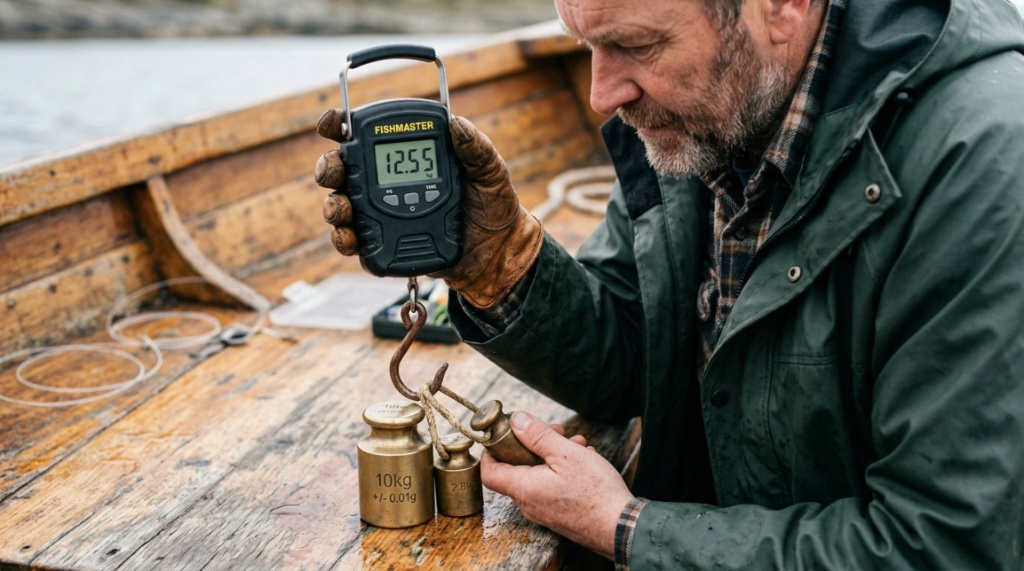
You should re-test your fish scale at the beginning of every fishing season and every time the scale has been dropped on a hard surface, exposed to a significant saltwater dunking, or stored in extreme cold/heat for over a month. A scale that is off by just 1% can mean the difference between a lake record and a “close but no cigar” story.
Seasonal Calibration Schedule
Set reminders for these specific times to keep your scale honest:
- Spring (March): Once the water warms and bass start hitting, re-verify your zero point before the first tournament.
- After a Saltwater Trip: Even if the scale is waterproof, salt crystals can build on the hook. Clean and re-test immediately after any Gulf trip.
- Post-Impact: The cardinal rule is the “drop rule.” If you drop it from waist height onto concrete, you must retest. The force can misalign the internal load cell.
Signs Your Scale is Lying to You
Your scale might not be testable if it shows these symptoms:
- It takes longer than 3 seconds to stabilize.
- It displays “ERR” or jumps numbers randomly when the weight is still.
- The hook or shackle has visible rust or pitting.
- The LCD screen has a dead segment.
If you see these, do not just recalibrate—replace the unit. The mechanical integrity is compromised.
Can You Calibrate a Fish Scale Yourself, or Does It Need a Pro?
Many digital scales have a manual calibration mode accessible via a button sequence, but you need a certified calibration weight to perform the adjustment. If you do not have one, you cannot accurately calibrate a scale yourself. You can only verify its accuracy. Actual calibration requires resetting the scale’s internal zero and span points.
When to Use the Manual Calibration Mode
If your scale has a “CAL” button or a code in the manual, you can do a basic 10-lb or 50-lb calibration. Here is the typical process (but consult your specific manual):
- Turn the scale off.
- Press and hold the “MODE” or “UNIT” button and turn the scale on.
- Wait for the screen to flash a calibration weight (e.g., 10.00 or 20.00).
- Hang the exact specified weight on the hook.
- Wait for the screen to flash “PASS” or “END.”
- Turn off and back on.
This process is only as good as the weight you hang. If you use a rusty 10-lb plate that actually weighs 9.8 lbs, you are cementing an error into the scale.
Why Professional Calibration is Crucial for Tournament Anglers
In tournament fishing, the penalty for a false reading is disqualification. Professional calibration services use Class F weights that are traceable to the National Institute of Standards and Technology (NIST). They adjust the scale’s internal potentiometers or software coefficients. This is a paid service, but if you are serious about record claims, it is worth the $20-$40 fee annually.
How Do You Test the “Peak Hold” Feature on a Fish Scale?
To test the peak hold feature, you must apply a sudden, violent force to the scale hook—simulating a fish’s head thrash—and check if the scale locks the highest force value without spiking to an inaccurately high number. A good peak hold will freeze the reading within 0.1 seconds and hold it indefinitely until you press the reset button.
Step-by-Step Peak Hold Test
This is critical because a dead fish hangs still, but a live fish jerks. Here is how to mimic that:
- Hang a 5-lb weight on the hook. Wait for the stable weight reading.
- While the scale is reading, sharply jerk the weight upward by about 6 inches using the top handle.
- Check the displayed number. The “peak” should read slightly above 5 lbs (due to acceleration) but should not read 10 lbs for a 5-lb weight.
- Excessive spikes indicate a software issue or a mechanical looseness in the hook assembly.
Why “Peak” vs. “Live” Weight Matters in Texas
Most Texas tournaments require a “live weight” on certified scales. However, if you are practicing catch-and-release and want to minimize handling time, a peak hold is useful. Just remember: a peak hold reading on a fish scale is always higher than the actual static weight. For trophy documentation, use the stable weight mode, not the peak hold.
What Waterproof Rating (IPX) Do You Need for Texas Conditions?
You need an IPX6 rating minimum for freshwater use and IPX7 for any saltwater wading or kayak fishing. IPX6 means the scale can handle powerful water jets (like a rainstorm or a spray of saltwater from a boat wake). IPX7 means it can be submerged in up to 1 meter of water for 30 minutes without damage.
Understanding the IPX Scale
The “X” in IPX means it is not rated for dust ingress but focuses on water. Here is the breakdown:
- IPX4: Protected from splashing water. Not suitable for heavy rain.
- IPX5: Protected from water jets. Good for light rain, but not submersion.
- IPX6: Protected from powerful water jets. Perfect for boat splash.
- IPX7: Protected from immersion. The safe bet for kayak anglers who might capsize.
If a scale claims “waterproof” but does not list an IPX rating, be very skeptical. They might just be corrosion-resistant, which means the internals are coated but not sealed against water ingress.
Testing Your Scale’s Waterproofing
Do not dunk your scale before it dries if you have just tested it with saltwater. Here is a safe test:
- Fill a shallow bucket with fresh water.
- Submerge the scale body (not the hook, which is usually unprotected) for 5 seconds.
- Remove and shake off excess water.
- Press the “ON” button. If the display flickers or numbers ghost, the seal is compromised.
Only perform this test on a scale rated IPX6 or higher.
How to Test the Accuracy of a Scale’s Tare Function
The tare function allows you to zero out the weight of a net, a stringer, or a wet towel. To test it, you must hang a container on the scale, press the tare/zero button to set it to 0.0, then add a known weight to ensure the reading equals the weight of the added item only, not including the container.
The Tare Test Process
Here is the fast way to verify this:
- Hang a 2-lb metal clip on the hook. Wait for the stable reading (should read 2.0 lbs).
- Press the “TARE” or “ZERO” button. The display should reset to 0.0.
- Add a 1-lb weight to the clip. The scale should read 1.0 lbs (not 3.0 lbs).
- Remove the 1-lb weight. The scale should read 0.0 again.
If the scale reads 0.5 lbs when you remove the weight, the tare function is drifting, which means the internal load cell is unstable.
Common Tare Mistakes Anglers Make
Do not use the tare function to “zero out” a scale that is not at zero when turned on. This is a band-aid for a mechanical issue. If the scale does not read 0.0 when you turn it on with no load, the load cell is misaligned and needs service, not a tare adjustment.
Which Weight Units Matter Most for Texas Anglers?
Texas anglers should primarily use pounds and ounces (lbs/oz) for freshwater bass fishing, but if you fish the Gulf Coast for tarpon or sharks, you might want a scale that also reads in kilograms or decimal pounds for easier catch-and-release calculations. The scale must have a high-contrast display to read these units in direct sunlight.
Ounces vs. Decimal Pounds
- Ounces (lb:oz): Used by tournament weigh-ins for precision. A bass weighing 8 lbs 14 oz is specified exactly.
- Decimal Pounds (e.g., 8.875): Better for scientific data and charters where digital GPS logs are kept.
The best scales allow you to toggle quickly. If you are comparing local records, ensure you are looking at the same unit system. A misread of 0.5 oz in conversion could make a difference in a small tournament.
The Importance of Backlit Displays in Low Light
Texas fog can roll in early morning. A backlit display is not just a luxury; it is a necessity for pre-dawn fishing. Test the backlight by pressing the button and covering the scale with your hand in the sunlight—if you can still see the numbers, the contrast is good.
Frequently Asked Questions
Can I use a luggage scale instead of a fish scale?
No. Luggage scales have a low internal resolution and are not designed to handle sudden impact forces or moisture. They will give a plausible reading on a static weight but will fail when the fish twists. The hook design also usually prevents weighing live fish.
How often should I calibrate a heavy-duty fish scale?
You should do a verification test (using a known weight) at least once a month during peak fishing season. A full professional calibration is recommended annually or after any significant impact to the unit.
Is a heavier capacity scale less accurate on small fish?
Generally, yes. A 500-lb-capacity scale measuring a 1-lb fish is working far outside its optimal window. This is why a dedicated heavy-duty scale (50-100 lbs) is better for the bass and redfish you’ll chase in Texas.
What does “tare” mean on a fish scale?
“Tare” is the function that subtracts the weight of an item already hanging on the hook (like a net or a wet bag) so you only get the net weight of your catch. It sets the current load as the new zero point.
Why does my digital scale fluctuate even when the fish isn’t moving?
This typically happens at the 0.1-lb mark due to wind or vibration through the boat deck. If it jumps continuously without wind, it might be a dying battery. Replace the battery before assuming the calibration is off.
Can saltwater permanently ruin a fish scale?
Yes. Even if the body is IPX7 rated, saltwater can corrode the hook’s hinge pin and the internal metal components if they are not 100% sealed. Always rinse your scale with fresh water after every saltwater trip, even if it claims to be waterproof.
How do I know if my fish scale is legal for tournament use?
Tournament scales must be certified to display weights in specific increments (usually 0.01 lbs). You must verify that your scale has a certification sticker from a recognized body. A standard consumer scale is rarely legal for official weigh-ins unless used as a backup.
Conclusion:
Testing your heavy-duty fish scale is not a chore—it is the only way to protect the integrity of your catch stories. From understanding the mechanics of load cells to performing the bucket test and verifying peak hold accuracy, you now have a complete arsenal of knowledge to ensure your scales are truthful. Reliability in the Texas heat and salt is built on the fundamentals we covered. Before you head out for your next dawn patrol, take five minutes to verify your equipment. Your trophy deserves an exact number, and you deserve the peace of mind that comes with a scale you can trust. Go get them, and make sure the weight is right.