
If your dog can destroy a “tough” toy in under five minutes, you know the struggle is real. You buy a promising new toy, hand it over, and within an hour you’re picking foam chunks off the carpet. It’s frustrating, expensive, and frankly, a little impressive. The real challenge isn’t just finding something strong; it’s finding something that is safe, engaging, and actually matches your dog’s specific chewing style. This guide breaks down exactly how to evaluate, choose, and maintain durable dog toys for chewers so you can stop wasting money and keep your pup happily occupied.
Key Takeaways
- Match the toy material to your dog’s chew style—”hard chewers” need different materials than “destructive chewers.”
- Prioritize safety by understanding the trade-offs between hardness, durability, and dental health.
- Size matters more than you think; a too-small toy is a choking hazard, while a too-large toy may be ignored.
- No toy is indestructible; inspect toys regularly and replace them at the first sign of critical wear.
- Rotate toys to maintain your dog’s interest and prolong the lifespan of each item.
Understanding Your Dog’s Chew Style
Before you even look at a product label, you need to assess how your dog chews. There is a massive difference between a dog that gently mouths a toy and one that systematically tries to disassemble it. Identifying your dog’s category is the first and most crucial step in selecting durable dog toys for chewers that will last longer than a single afternoon.
Most heavy chewers fall into a few distinct categories. The “power chewer” uses the back molars to crush and grind, often targeting the seams or weak points of a toy. The “rip-and-tear” chewer uses front incisors to puncture and shred, often pulling stuffing or fabric out. Finally, the “sucker” or “grouter” holds the toy and gnaws continuously, creating a lot of friction but less structural damage. Your strategy will differ based on which behavior is dominant.
Assessing Bite Force and Persistence
While breed can give you a hint (Pit Bulls, Labradors, and German Shepherds are notorious power chewers), individual personality matters more. A small Jack Russell can be far more destructive than a laid-back Golden Retriever. Watch how your dog interacts with existing toys. Do they focus on the weakest point, or do they chew indiscriminately? Are they satisfied after twenty minutes, or do they obsess for hours until the toy breaks? This persistence level determines the required durability rating.
Material Science: The Core of Durability
Once you identify your dog’s distinct bite strength, evaluating the physical properties of toys becomes essential, especially since marketing claims like “indestructible” often obscure real-world performance. Natural rubber and high-grade thermoplastic polyurethane (TPU) represent the gold standard for aggressive chewers, offering an optimal balance of structural resilience and dental-safe flexibility that yields slightly under pressure without puncturing. Conversely, while rigid nylon excels at scraping dental plaque, its inherent brittleness makes it susceptible to cracking under acute, high-impact force; similarly, traditional rope fibers tend to fray rapidly, posing significant gastrointestinal obstruction risks when ingested. Investing in these resilient materials is particularly vital during outdoor play in cooler months, when shifting weather alters your dog’s exercise routine—a dynamic explored further in our guide on care for your dog in the autumnal season to ensure safety and engagement year-round.
The Trade-Off Between Hardness and Safety
Here’s where many owners go wrong: they buy the hardest toy possible, thinking it will be the most durable. While a hard nylon bone might resist punctures, it poses a significant dental risk. If your dog bites down on a hard surface with a twisting motion, they can fracture a tooth (especially the large molars used for grinding). A durable toy should be firm enough to resist punctures but have a slight “give” when pressed. The “fingernail test” is a good standard—if you can press your thumbnail into the toy and it leaves a small dent, it is likely safe for vigorous chewing. If it feels like a rock, it is likely too hard for aggressive chewers.
Why Rubber Beats Plastic for Aggressive Chewers
Injection-molded plastics and cheap thermoplastics often have seams and mold lines that create weak points. Aggressive chewers will find these flaws within minutes and exploit them, splintering the plastic into sharp shards. High-quality natural rubber, however, is molded in a way that creates seamless surfaces. This material can withstand high compression forces without cracking, making it the safest and most reliable option for the highest level of chewers. Look for terms like “natural rubber,” “TPR,” or “TPE” rather than generic “plastic.”
Evaluating Shape, Size, and Design
Durability isn’t just about the material; the geometry of the toy plays a massive role in its survival. A thick slab of rubber is hard to destroy, but if it has thin protruding legs, ears, or tails, those become target areas. You need to consider how the shape interacts with your dog’s mouth.
For a power chewer, choose toys that are “one solid mass.” Avoid toys with appendages that can be chewed off and swallowed. The toy should ideally be too large for the dog to fit entirely into its mouth. While a huge toy might look unwieldy, it forces the dog to chew on the middle section, which is usually the thickest and strongest part.
Choosing the Correct Size
Many owners buy toys that are too small, creating a choking hazard and making the toy easier to destroy. As a rule of thumb, the toy should be significantly larger than your dog’s mouth. If your dog can easily open its jaw and completely cover the toy, it is too small. For heavy chewers, an inch of space on all sides is a good minimum. A larger toy not only protects your dog but also makes it structurally harder to bend and break.
Design Features That Extend Lifespan
Look for toys designed with “chew zones”—thicker areas intended for the back molars—and flatter edges that are harder to get a grip on. Balls with a solid core are better than hollow ones, which collapse and crack under pressure. Avoid toys with squeakers if you suspect your dog will try to “hunt” the squeaker out, as this often leads to them ripping open the outer shell to get to the inner mechanism.
The Fine Print: Maintenance and Lifespan
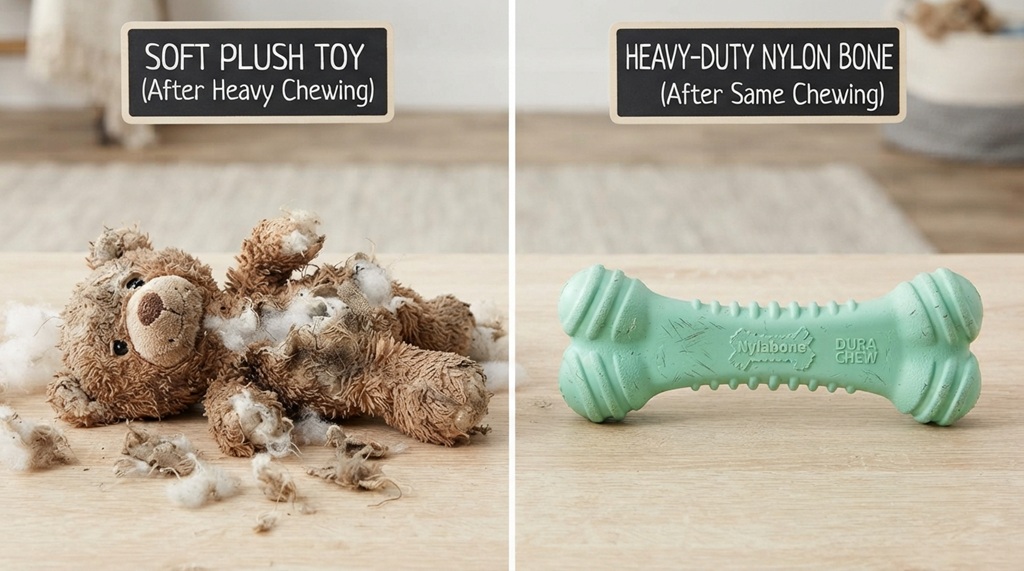
Even the best rubber toys will eventually wear out. The lifespan depends entirely on your dog’s intensity and the frequency of use. It is critical to understand that no material is indestructible. The goal is to maximize the time between purchase and disposal, and to know when to retire a toy before it becomes dangerous.
When a rubber toy becomes torn, it’s time to go. Small nicks and scratches are fine, but if you can pull off a chunk of rubber with your fingers, your dog can do it much easier. Ingested rubber pieces can cause gastrointestinal blockages, which often require surgical intervention.
Cleaning and Hygiene
Chew toys accumulate saliva, dirt, and bacteria. Since they are designed to be chewed for hours, they need regular cleaning. Most rubber toys are dishwasher safe (top rack, no heat cycle) or can be washed with warm water and mild dish soap. Avoid using harsh bleaches or chemicals. Nylon toys can be scrubbed with a stiff brush to remove plaque buildup. Drying them thoroughly prevents mold growth in any crevices.
When to Replace a Toy
Inspect your dog’s toys at least once a week. Replace the toy if it has: – Torn pieces that can be removed with your fingers. – Deep cracks that compromise the structural integrity. – Rough, jagged edges that could cut gums. – Any internal parts (like a rope core) exposed to the outside. Adopting a “when in doubt, throw it out” policy is the best way to protect your dog’s health.
Practical Tactics for Prolonging Toy Life
Even with the most durable products, you can extend their life significantly by changing how you deploy them. Simply handing over a toy and letting the dog work on it until destruction is the fastest way to shorten its lifespan. Here are a few tactics to implement immediately.
Instead of leaving toys scattered around the house, use a rotation system. Keep two or three toys in circulation and store the rest out of sight. When the dog gets bored with the current toy, swap it out for a “new” one. This novelty factor keeps the dog interested and prevents them from spending hours obsessively working on a single weak point.
The “Supervision” Rule
During the initial introduction of a new toy, supervise your dog closely. This is not just about safety; it is about learning. If you see your dog focusing on a specific seam or edge, redirect them to a stronger part of the toy. If they manage to rip off a piece, remove the toy immediately. This teaches them that destructive behavior leads to the toy being taken away, encouraging them to chew more appropriately.
Using Treat-Dispensing Toys Strategically
Toys like Kongs or similar hollow rubber devices are excellent for chewers, but they are often misused. If you fill a Kong with wet food and freeze it, you create a long-lasting challenge that satisfies the dog’s need to chew while wearing them out mentally. However, the edges of the hole can become weak if the dog focuses on them. Always check the rim of the opening for signs of stress, as this is often where cracks start to form on an otherwise healthy toy.
Frequently Asked Questions
Are “indestructible” dog toys safe?
No toy is truly indestructible. Most “indestructible” claims are marketing labels. While these toys are designed to withstand high-force chewing, they can still be broken, especially if the dog focuses on a seam or uses a twisting motion. They are generally safe when used under supervision, but you should treat them as “highly resistant” rather than indestructible.
Can chewing on hard rubber damage my dog’s teeth?
Yes, it can. If the rubber is too hard, the dog can fracture a tooth. To avoid this, choose toys that have a slight “give” when you press on them with your thumb. If you cannot indent the material, it is likely too hard for your dog’s teeth. Always monitor your dog for signs of discomfort while chewing.
What is better for heavy chewers: nylon or rubber?
For heavy chewers, high-quality rubber (specifically natural rubber or TPU) is generally safer and longer-lasting than nylon. Nylon is hard and brittle; it can crack and splinter, leaving sharp edges. Rubber is more shock-absorbent, making it gentler on teeth while still being difficult to puncture.
How do I stop my dog from destroying every toy immediately?
Start by selecting the right material (natural rubber) and size (larger than the mouth). Introduce the toy during supervised play, and redirect destructive behavior toward the stronger parts of the toy. Additionally, use toy rotation to keep the dog interested and manage their energy levels with physical exercise before giving them a “chew session.”
Is it safe to give my dog a rope toy?
For light chewers, rope toys are fine. For aggressive, destructive chewers, they are risky. The fibers can fray and be ingested, leading to intestinal blockages. If you do use rope toys, only use them for supervised tug-of-war games, and discard them as soon as you see loose strings.
Conclusion
Finding the right toy for a power chewer doesn’t have to be a guessing game. By evaluating your dog’s specific chewing style, understanding the material properties, and choosing the correct size, you can significantly reduce the risk of destruction and injury. Remember that durability is about the combination of material and design, not just marketing hype. Prioritize safety over hardness, and always inspect toys for signs of wear. With a strategic approach and a commitment to supervision, you can keep your furry friend entertained, happy, and safe, without breaking the bank on replacement toys.