
It is 3 a.m., your newborn is finally asleep on your chest, but your own neck is stiff and your lower back is screaming for support. In that moment, you might look at the standard pillow on your bed and wonder why it isn’t doing the job. While a regular pillow can prop up your head, it lacks the specific structure needed to support a baby’s weight during a feed. This is where a dedicated nursing pillow changes the game. If you are evaluating specific options, a Momcozy original nursing pillow hands on review can help clarify how these ergonomic tools function in practice. Understanding the mechanical difference between these two items is the first step toward saving your back and your sanity.
Quick Answer
The primary difference lies in shape and purpose. A regular pillow is flat and designed to support the head while lying down. A nursing pillow is typically crescent or U-shaped with firm filling designed to wrap around the waist, elevating the baby to breast or bottle level. This elevation reduces strain on the parent’s arms, neck, and back during feeding.
Key Takeaways
- Ergonomics: Nursing pillows are designed to bring the baby to the breast, preventing the parent from hunching over.
- Structure: Unlike soft bed pillows, nursing pillows use firmer filling to maintain their shape under the baby’s weight.
- Safety: Regular pillows are a suffocation hazard for infants and should never be used for sleep positioning.
- Versatility: While regular pillows are for sleeping, nursing pillows can double as tummy time aids or sitting support for older babies.
Purpose and Design: Why Shape Matters
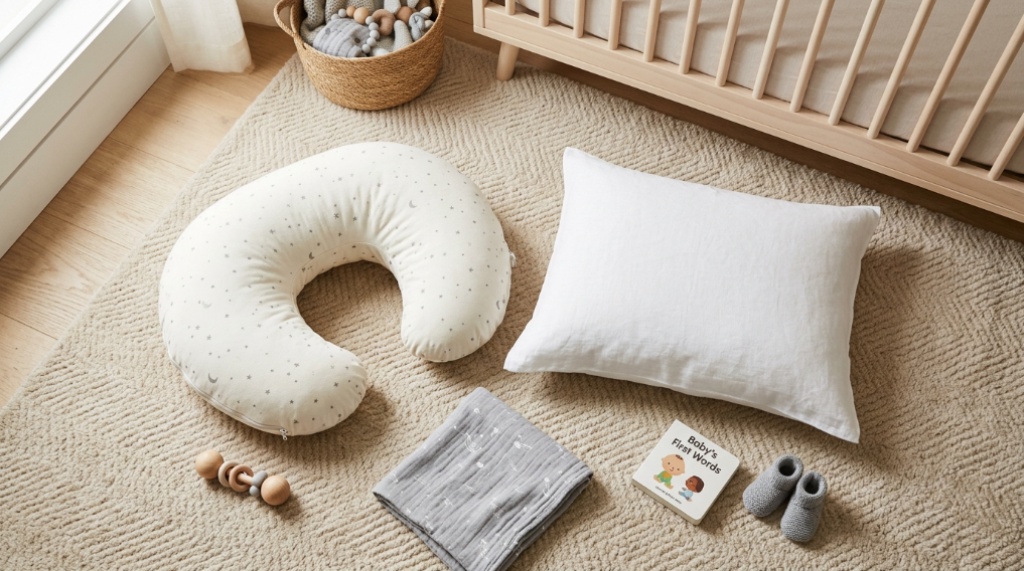
The fundamental difference between these two items comes down to geometry and density. A regular pillow is rectangular and flat, designed to conform to the curvature of a human head and neck. A nursing pillow is engineered to fit around a human torso.
When you feed a baby, you essentially need a shelf that connects your body to the baby’s body. A regular pillow slides around and flattens out under the baby’s weight. A nursing pillow, often shaped like a crescent or a “U,” hooks around the parent’s waist. This anchoring prevents the pillow from shifting when the baby moves, If you are looking to refresh your living space on a budget after setting up the nursery, check out our guide on How to Save on Couch Pillow Multi-Packs.
Firmness and Fill
Regular pillows are usually filled with down, feathers, or shredded memory foam. These materials are designed to be soft and plush for sleeping comfort. However, this softness is a disadvantage for feeding. If you place a 10-pound baby on a soft down pillow, the pillow compresses, and the baby sinks down.
Nursing pillows typically use solid block foam or tightly packed polyester fiber. This firmness is intentional. It allows the pillow to keep the baby elevated at the correct height without collapsing. If you try to use a regular pillow for feeding, you will likely find yourself constantly fluffing it or folding it in half to get the right height, which often creates an unstable surface.
The Ergonomics of Feeding: Preventing “Mommy Wrist” and Back Pain
The most compelling reason to choose a nursing pillow is injury prevention. Feeding a newborn requires holding a weight in a static position for 20 to 40 minutes, multiple times a day. Without proper support, this repetitive strain leads to neck pain, shoulder tension, and lower back issues.
When using a regular pillow, parents often try to stack two or three pillows to reach the necessary height. This setup is rarely stable. The parent then has to use their arm muscles to hold the baby in place, which prevents relaxation. Over time, this can lead to tendinitis in the wrist (often called “mommy wrist”) or chronic back pain.
A nursing pillow solves this by filling the gap between your lap and the baby. It supports the baby’s weight entirely, allowing your arms to rest. This support structure keeps the baby’s mouth level with the breast or bottle, preventing you from hunching your shoulders or craning your neck to look down.
Comparison Table: Nursing Pillow vs. Regular Pillow
The following table breaks down the practical differences you will notice in daily use.
| Feature | Nursing Pillow | Regular Pillow |
|---|---|---|
| Primary Shape | Crescent, U-shape, or wedge | Rectangular |
| Main Function | Ergonomic support for feeding | Head and neck support for sleep |
| Firmness | Firm (Foam or dense fiber) | Soft to Medium |
| Stability | High (hooks around body) | Low (slides easily) |
| Secondary Uses | Propping, tummy time, sitting support | Sleeping, decoration |
| Portability | Bulky (though some have handles) | Easy to move |
Safety Considerations and Limitations
Safety is a critical distinction between these two items. While both are soft objects, the intended use dictates the risk level.
The AAP (American Academy of Pediatrics) and safety organizations consistently warn against placing infants to sleep on nursing pillows or regular pillows. Both pose a suffocation risk if a baby turns their face into the fabric and cannot move away. However, the risk profile differs slightly in usage.
Nursing pillows are designed for supervised, awake feeding sessions. Because they are firm, they don’t conform to a baby’s face in the same way a soft down pillow might, but they are still not safe for unsupervised sleep. Regular pillows are designed for sleep but are dangerous for infants due to their softness and ability to block airways.
If you are using a nursing pillow, you must stay awake and supervise the session. Never leave a baby unattended on a nursing pillow, and never use one as a bed for the baby.
Practical Uses Beyond Feeding
One of the hidden benefits of a nursing pillow is its longevity. A regular pillow stays on the bed. A nursing pillow often becomes a multi-purpose tool in the first year of a baby’s life.
- Tummy Time: The incline of a nursing pillow can help a baby practice lifting their head. You can place the baby on their stomach over the curve of the pillow, which takes pressure off their chest and makes the exercise less frustrating.
- Sitting Support: For babies learning to sit up, a U-shaped pillow placed behind them can act as a soft barrier in case they topple backward.
- Post-Surgery Support: Some parents find that the firmness and shape of a nursing pillow are helpful for supporting the abdomen after a C-section, keeping pressure off the incision site.
A regular pillow rarely serves these functions effectively because it lacks the structural integrity to hold a baby in an upright or inclined position without collapsing.
When a Regular Pillow Might Work
Is a nursing pillow strictly necessary? Not always. There are scenarios where a regular pillow is sufficient, provided you understand the trade-offs.
If you are feeding in a reclined position (laid-back breastfeeding), you are essentially using your body as the pillow. In this case, you might only need a small regular pillow for head support. Similarly, if you are traveling and space is extremely limited, you might not want to pack a bulky nursing pillow.
However, in these cases, you often have to compensate with your own body mechanics. You might need to sit cross-legged to create a lap shelf or use rolled-up blankets to prop the baby. While these methods work in a pinch, they are rarely as comfortable or consistent as a dedicated nursing pillow for daily, long-term use.
Choosing the Right Fit
If you decide to go with a nursing pillow, the fit is more important than the brand. A pillow that is too thick will push the baby too high; one that is too thin won’t provide relief.
You want a pillow that fits snugly around your waist without a large gap. The filling should be firm enough that it doesn’t bottom out when the baby lies on it, but soft enough to be comfortable against your skin. Removable, washable covers are also a practical feature, as spit-up and milk leaks are inevitable.
A regular pillow doesn’t require a “fit” check; you just sleep on it. But a nursing pillow is a wearable tool. It is worth testing the return policy or checking the dimensions to ensure it matches your torso length and waist size.
Frequently Asked Questions
Can I just use a regular pillow for breastfeeding?
You can, but it is generally less comfortable. You will likely need to stack multiple pillows to get the correct height, and they may slip out of place. This can lead to back and neck strain because you have to hold the baby’s weight with your arms.
Is a nursing pillow safe for the baby to sleep on?
No. Pediatricians warn against letting a baby sleep on a nursing pillow. They are not firm enough for safe sleep and pose a risk of suffocation or positional asphyxiation. Always transfer the baby to a firm, flat mattress for sleep.
How long do you need a nursing pillow?
Most parents use a nursing pillow for the first 6 to 12 months. It is essential during the newborn phase when feeding is frequent. As the baby grows and becomes more mobile, you may use it less for feeding but more for sitting support or tummy time.
Do nursing pillows help with C-section recovery?
Yes, many parents find them helpful. The pillow can keep the baby’s weight off the incision during feeding. Some mothers also use the pillow to support their abdomen when coughing or laughing, providing a gentle counter-pressure.
Can I wash a nursing pillow in the washing machine?
It depends on the model. Many have removable covers that are machine washable. However, the inner foam or fiber insert often needs to be hand-washed or spot-cleaned, as machine agitation can destroy the filling. Always check the specific manufacturer’s instructions.
Is a Boppy or Momcozy pillow better than a standard bed pillow?
For feeding, yes. These specialized pillows are designed to wrap around the waist and hold the baby at the correct elevation. A standard bed pillow is designed for lying down, so it tends to slide away and flatten under weight.
Conclusion
Choosing between a nursing pillow and a regular pillow depends on the activity. For sleeping, a regular pillow is the correct tool. For feeding a baby, a nursing pillow is the superior choice because it provides the firmness and shape needed to support the baby’s weight and protect your posture. While a regular pillow is cheaper and easier to find, it cannot replicate the ergonomic benefits of a dedicated nursing pillow. If you feed your baby multiple times a day, investing in a quality nursing pillow is a practical decision for your physical comfort.