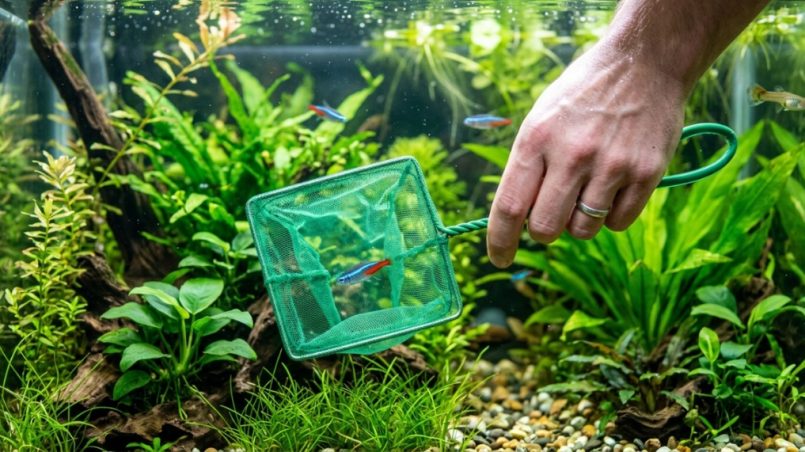
You’ve just spent an hour carefully acclimating a new fish, only to watch it bolt behind the heater the second you try to net it. You reach for your net, but the mesh snags on a decoration, or the handle bends under pressure, or—worst case—the frame rubs against your fish’s delicate scales. Sound familiar? Choosing the wrong net can turn a simple task into a stressful disaster for both you and your aquatic pets. This guide will help you identify exactly what makes the right net for aquarium tank maintenance, ensuring safer handling, less mess, and a calmer experience every time you dip into the water.
What Is the Right Net for an Aquarium Tank?
The ideal net balances mesh size, frame shape, handle length, and material quality to match the specific needs of your tank inhabitants and setup. A net that works perfectly for a 10-gallon betta tank will flop miserably in a 75-gallon cichlid community.
Mesh Material Matters More Than You Think
Nylon mesh is standard for most freshwater tanks—it’s soft, dries quickly, and resists mildew. Polyester mesh offers slightly more rigidity, which helps when scooping heavy fish like goldfish. Avoid metal mesh unless you’re dealing with extremely large predatory fish; metal can rust or damage fish slime coats.
Frame Shape Determines Access
Round nets are great for open-water scooping but struggle in tight corners. Triangular and square frames slide into cramped spaces behind driftwood or between rocks. If you have a heavily planted tank, a narrow, long-handled net with an angled frame will save you hours of frustration.
Handle Length Should Match Tank Depth
A 12-inch handle works for shallow breeding tanks, but a 24-inch or longer handle is essential for deep standard aquariums. Short handles force you to submerge your arm, which spooks fish and disrupts the scape. Long handles give you leverage without disturbing the environment.
Why Net Selection Impacts Fish Health and Tank Stability
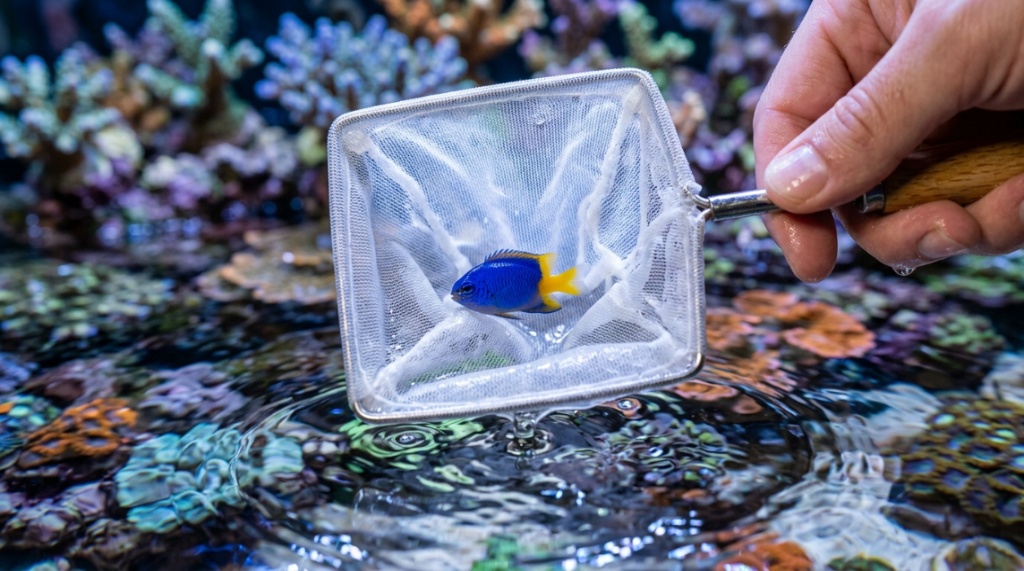
The wrong net can strip a fish’s protective slime coat, transfer diseases between tanks, or stress fish to the point of injury. Nets are not just tools—they are extensions of your care routine that directly affect water quality and fish immunity.
Slime Coat Protection Is Non-Negotiable
A fish’s slime coat is its first defense against parasites, bacteria, and fungal infections. Rough, wide-gauge mesh can scrape this layer off in seconds. Fine, soft mesh (around 1–2 mm openings) minimizes friction and preserves the coat. For delicate species like discus or angelfish, always use a micro-mesh net.
Cross-Contamination Risks Are Real
Using the same net between quarantine tanks, display tanks, and sumps can spread pathogens like ich or columnaris. Dedicate separate nets for each system, or invest in nets that can be fully disassembled and boiled safely. Nylon handles with removable mesh cups are the safest bet for sterilizing.
Stress Reduction Equals Better Survival Rates
Fish panic when netted. A net that is too small forces you to chase the fish, prolonging capture time. A net that is too large may trap fish against the mesh, causing fin tears. The right net for aquarium tank work should let you capture a fish in one smooth, swift motion without cornering or crushing it.
How to Choose Net Size Based on Tank Volume
Net size should correlate directly with both tank dimensions and the size of your fish. A small net in a large tank creates unnecessary chasing, while an oversized net in a small tank feels clumsy and dangerous.
Nano Tanks (Under 10 Gallons)
For small tanks, choose a net with a 2- to 3-inch frame opening and a 6- to 8-inch handle. Large nets can’t maneuver around sponge filters or small heaters. Use fine mesh (0.5–1 mm) to protect tiny shrimp fry or nano fish like rasboras.
Standard Tanks (20–55 Gallons)
This is the sweet spot for a 4- to 5-inch net with a 12- to 18-inch handle. Medium mesh (1.5–2 mm) works well for community fish like tetras, mollies, and corydoras. Ensure the net bag depth is at least 4 inches to prevent fish from flipping out during transfer.
Large Tanks (75 Gallons and Above)
You need a 6- to 8-inch net with a 24-inch or longer handle. Deep tanks require reach. For adult oscars, arowanas, or large plecos, consider a net with a reinforced frame and heavy-duty mesh rated for fish over 12 inches long. A collapsible net with a telescoping handle is ideal for large systems.
Which Mesh Type Works Best for Different Fish Species?
Different fish have different needs. Mesh that is perfect for goldfish will shred a betta’s fins. Matching mesh type to species prevents injury and stress.
Delicate Fish (Betta, Discus, Angelfish, Killifish)
Use soft micro-mesh with openings smaller than 1 mm. This mesh has zero snag points and won’t catch on long fins or sensitive barbels. A bag depth of at least 5 inches is critical so the fish can rest fully inside the net without folding its body.
Hardy Community Fish (Guppies, Platies, Tetra, Danios)
Standard fine mesh (1–2 mm) works perfectly. These fish are robust but still benefit from smooth handling. Avoid cheap nets with rough, woven edges that can fray and catch on scales.
Large Predators (Cichlids, Oscar, Arowana, Bichir)
Heavy-duty rubber-coated mesh or knotless nylon with 2–4 mm openings is best. These fish have powerful muscles and sharp spines; a weak net will break. Rubber-coated mesh is gentle on slime coats and won’t snag on teeth or gill plates.
Bottom Dwellers (Corydoras, Loaches, Plecos)
Fine mesh is essential for corydoras and loaches, which have delicate barbels that can get caught in large openings. For plecos, use a square net that you can slide under the fish without touching its spiny dorsal fin.
Can You Use the Same Net for Freshwater and Saltwater?
Technically yes, but practically no. Saltwater introduces corrosion, mineral buildup, and higher disease transmission risks that make a dedicated saltwater net a smarter investment.
Corrosion Concerns in Saltwater
Saltwater accelerates corrosion on metal parts. Even stainless steel handles can pit over time. Plastic and anodized aluminum handles hold up better. Always rinse your net in freshwater immediately after saltwater use and let it dry completely.
Disease Transfer Between Tanks
Saltwater parasites like Cryptocaryon irritans (marine ich) are highly contagious. Using the same net between systems is a recipe for disaster. Label one net “salt quarantine” and another “salt display” and never mix them.
Mineral Buildup Slows Performance
Calcium deposits can clog fine mesh and make nets stiff. Soaking nets in white vinegar for 15 minutes once a month removes buildup without damaging the material. Rinse thoroughly before reuse.
When Should You Upgrade to a Premium Net?
Budget nets often fail at the worst possible moment—during a fish transfer, a tank breakdown, or an emergency rescue. Upgrading is worth it when you notice specific signs of wear or when you keep high-value fish.
Signs You’ve Outgrown Your Current Net
- The handle bends when lifting a moderately heavy fish
- Mesh has frayed edges that snag on decorations or fish
- The frame has become loose or broken at the joint
- You find yourself chasing fish for more than 30 seconds
- You’ve had a fish jump out of the net during a water change
Features Worth Paying For
Premium nets typically include stainless steel or welded aluminum frames, replaceable mesh bags, ergonomic rubber handles, and knotless mesh that won’t trap debris. Look for brands that offer replacement parts so you don’t have to buy a whole new net when the mesh wears out.
When Budget Nets Actually Work Fine
If you keep only hardy fish in a simple tank below 20 gallons and rarely need to catch them, a basic nylon net will serve you well. Replace it yearly because nylon breaks down under UV light and constant wetting.
Looking to keep your fish room or home spotless while maintaining your tanks? Check out how to Save Money on Robot Vacuum & Mop Combos for your floors.
How to Measure Your Tank for the Perfect Net Fit
Measuring your tank is a five-minute job that prevents weeks of frustration. Don’t guess—measure.
Measure Tank Depth for Handle Length
Use a ruler or tape measure to find the distance from the tank rim to the deepest point in the substrate. Add 6 inches to ensure your hand stays above the water line. A 20-inch-deep tank needs a handle at least 26 inches long.
Measure Open Space for Frame Width
Look at your aquascape. Is there a clear center channel, or is the tank packed with hardscape and plants? Measure the widest open area between decorations. If it’s only 4 inches, a 3-inch net frame is safer than a 5-inch one that will get stuck.
Measure Fish Body Size for Bag Depth
Your net bag should be at least 1.5 times the length of your largest fish. A 6-inch fish needs a bag depth of 9 inches or more. This allows the fish to swim fully into the net and gives you room to lift without pinning it against the mesh.
How to Clean and Maintain Your Fish Net Properly
Proper maintenance extends net life by years and prevents disease outbreaks. Most hobbyists neglect this step, then wonder why their fish get sick.
Daily Rinse Protocol
After each use, rinse the net in dechlorinated water or tank water (not tap water, which contains chlorine that can damage mesh). Shake off excess water and hang the net to dry with the bag fully open to prevent mildew.
Weekly Deep Clean for Quarantine Nets
Soak quarantine nets in a 10% bleach solution (1 part bleach to 9 parts water) for 10 minutes, then rinse thoroughly and soak in dechlorinated water for another 10 minutes. Air dry completely. This kills bacteria, viruses, and parasites.
Monthly Inspection and Replacement Schedule
Check seams, handle joints, and mesh integrity monthly. Replace any net with visible fraying, rust spots, or loose stitching. Do not wait until a net breaks mid-use—replacement is cheap insurance.
How to Net a Fish Without Causing Injury
Even the best net is useless if your technique is poor. Proper netting technique reduces capture time and stress dramatically.
Step 1: Prepare the Tank
Turn off filters and powerheads so your fish don’t get swept into the intake during netting. If possible, dim the lights to calm nervous fish. Remove large decorations that give fish hiding spots.
Step 2: Use a Two-Net Strategy
One net drives, the other catches. Use a larger net as the “catcher” and a smaller net to gently guide the fish toward it. Never chase—guide. Cornering fish against the glass also works well because they cannot swim backward fast enough to escape.
Step 3: Lift Smoothly and Cover Immediately
Once the fish is inside the net, lift straight up without twisting or tilting. Transfer the fish to a waiting container with water from its own tank. Never hold a fish out of water for more than a few seconds—gill tissue collapses rapidly.
Frequently Asked Questions
How often should I replace my aquarium net?
Replace your net every 12 to 18 months for regular use, or sooner if you notice fraying, broken seams, or rust. Quarantine nets that are boiled weekly can last two years or more.
Can I use an aquarium net for pond fish?
Yes, but most pond nets are larger and have heavier mesh. A standard aquarium net is too small for koi or large goldfish. Look for pond-specific nets with reinforced frames and mesh openings of 3–5 mm.
What size net do I need for a 20-gallon tank?
A 4-inch frame with a 12- to 16-inch handle and 2 mm fine mesh works well for most 20-gallon community tanks. If you have large cichlids, size up to a 6-inch frame.
Is rubber-coated mesh better than nylon?
Rubber-coated mesh is gentler on fish slime coats and does not fray, but it is heavier and more expensive. Nylon is lighter, cheaper, and dries faster. Choose rubber for delicate fish and nylon for general use.
Can I sterilize a fish net by boiling it?
Yes, if the frame and handle are made of stainless steel and silicone. Plastic handles will warp. Only boil nets that are explicitly labeled as boil-safe. Otherwise, use a bleach soak as described above.
Do I need different nets for different tank sizes?
Yes. Using a tiny net in a large tank risks losing the net or injuring fish during prolonged chases. Using a huge net in a small tank damages scaping. Keep at least one small, one medium, and one large net.
What is the best net for fry and shrimp?
Use a micro-mesh net with openings under 0.5 mm. Standard nets allow baby shrimp and tiny fry to slip through the gaps. These nets are often called “brine shrimp nets” and are available in extra-fine mesh.
Your Next Step Toward Safer Fish Handling
Selecting the right net isn’t just about convenience—it’s a fundamental part of responsible fishkeeping that protects your fish, your scape, and your peace of mind. Start by measuring your tank depth and largest fish, then match mesh type to species. Invest in at least two nets: one general-use net and one quarantine net. Replace them before they fail, and always rinse after use. With the right net in hand, every water change, transfer, and rescue becomes faster, safer, and far less stressful for everyone involved. Make the smart choice today—your fish will thank you.